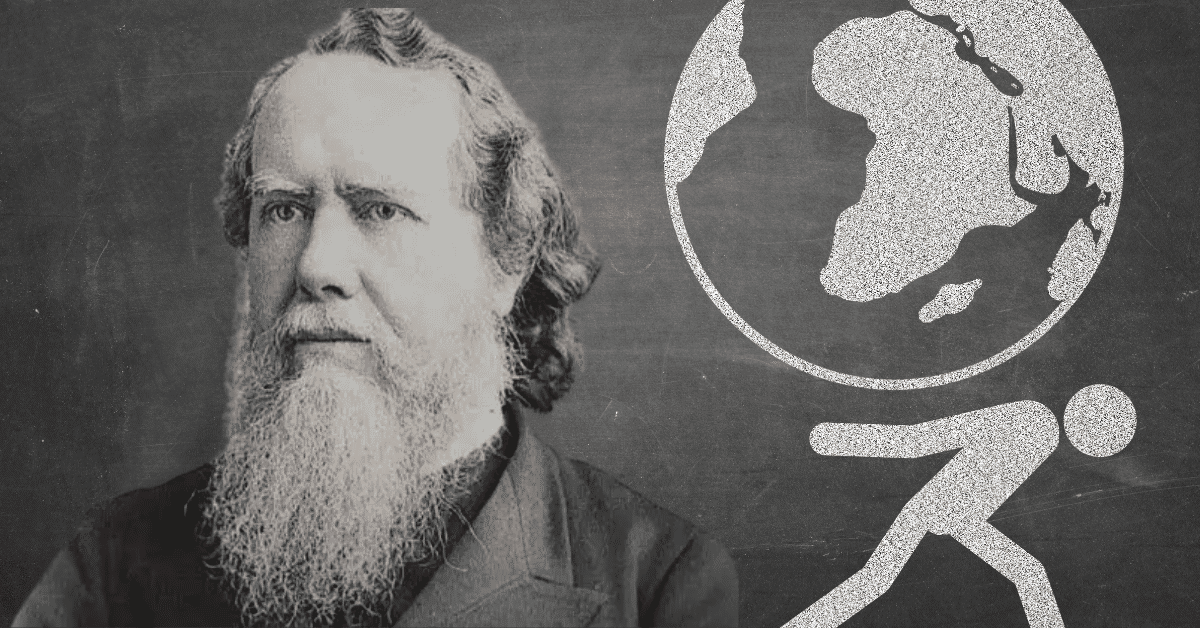
On Sunday, June 25, 1865, James Hudson Taylor walked along the sands at Brighton, England, carrying a burden that had been growing in him for months.
Taylor was already a seasoned missionary. He had spent years in China and had seen firsthand both the spiritual needs of the Chinese people and the limitations of the missionary efforts that were concentrated mostly in the coastal cities. He was troubled by vast interior of China, where millions of people lived. By 1865, the concern had become so consuming that Taylor later wrote that it left him with little rest and eventually affected his health.
The problem was not simply that Taylor had an idea for a new missionary organization. He was wrestling with whether he himself was willing to accept the responsibility that came with that idea. He feared the dangers that would face inexperienced missionaries in the interior or China, including rejection, illness, and persecution. He also knew that asking people to go would mean accepting responsibility for them once they did. His hesitation was because he understood the seriousness of the calling.
That afternoon, Taylor walked away from the crowds and onto the beach alone. In his own account, he describes the moment as one in which he surrendered himself to God for the work and gave up his insistence on knowing how everything would turn out. He wrote that the responsibility for the results and consequences had to rest with God, while his responsibility was simply to obey and follow.
Then he prayed for something remarkably specific: twenty-four fellow workers. He asked for two missionaries for each of the eleven inland provinces that had no missionary presence, along with two for Mongolia.
That prayer began what would eventually be known as the China Inland Mission.
Taylor did not return from Brighton with a large organization, a staff, or a secure financial foundation. He returned with a conviction that he believed God had given him, and he began taking the next steps. He wrote and circulated, China’s Spiritual Need and Claims, to make the needs of inland China more widely known. People began to come forward, and arrangements were made for a new mission.
Within a year, Taylor and a group of missionaries were on their way back to China. The Lammermuir party sailed in 1866, and the China Inland Mission began its work. The mission would eventually grow into an international movement. By the time Taylor died in 1905, the organization had hundreds of missionaries working throughout China’s provinces, along with hundreds of Chinese workers and more than 300 locations.
It is tempting to read a story like this and conclude that we need to simply, Dream bigger. Pray for something enormous. Step out in faith.
There is certainly a place for courageous faith, but I also think that Taylor’s story points to something much deeper.
The key moment on Brighton Beach was not when Taylor dreamed up an impressive missionary strategy. It was when he surrendered his need to control the outcome. He had been carrying the burden as though the entire future of the work depended upon his ability to make the right decisions and execute. What changed was his understanding of who really carried the responsibility.
We can become so accustomed to thinking about our lives and what God has called us to in terms of our own ability. When we do that we create a burden we were never meant to carry alone.Faith does not mean pretending that difficult circumstances do not exist. Taylor himself understood the risks and uncertainties involved in missionary work better than most people around him.
Faith mean remembering that God’s work ultimately belongs to God.
Taylor later wrote in A Retrospect that it was helpful to remember “the God-ward aspect of Christian work” that God’s work is not simply man’s work for God, but God’s work through His people. That is a freeing truth.
It means we can take our responsibilities seriously without believing that everything depends upon us. We can plan carefully, work diligently, give generously, pray faithfully, and still leave the final outcome in God’s hands.
It isn’t wrong to ask God to give us a larger vision, but we should start by asking Him to show us what faithfulness looks like today. It may mean something a bit radical like going overseas, as it was for Hudson Taylor. It may be serving faithfully in a local church, investing in a child, opening our home to someone who needs community, sharing the gospel with a neighbor, or simply obeying something God has already placed in front of us.
We do not know where the obedience will lead. Taylor certainly didn’t know everything that awaited him when he walked along that beach. He knew the need was enormous, he knew his own limitations, and he knew the road ahead would be difficult. What he did know was that he was willing to place the work and its results in God’s hands.
Faithfulness does not require us to know how God will accomplish His purposes. It requires us to trust Him enough to take the next step.
Hudson Taylor walked onto that beach carrying a burden he could not carry or solve or his own. He walked away having surrendered the burden to the God, that is where our own faith needs to begin.
“Lord, what are You asking me to do and am I willing to trust You with what I cannot do?”
That is not a prayer for people who have everything figured out. It is a prayer for people who are ready to trust God with the part of the story they cannot control.


